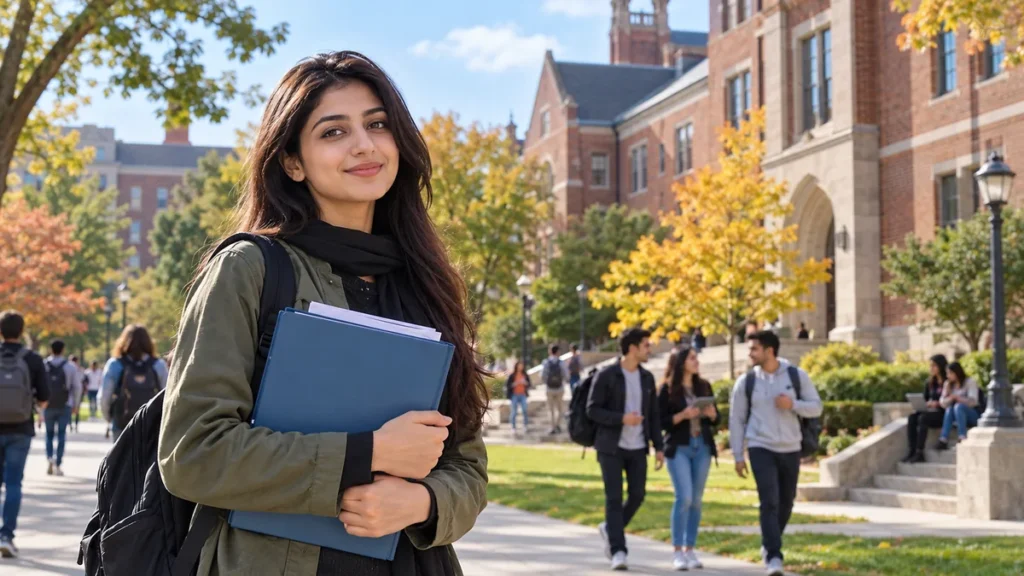
Navigating admissions, university options, funding options, practical training pathways, and student visa requirements for applicants from Pakistan.
Planning to study in USA from Pakistan? U.S. universities offer a wide range of degree programs and research opportunities. Choosing a course, comparing costs, applying for funding, and preparing a student visa application all require careful planning.
This guide explains admission requirements, estimated costs, funding options, student work rules, and the F-1 visa application process for Pakistani applicants.
Quick Facts for Pakistani Applicants
Study destinations include California, Texas, New York, Massachusetts, Illinois, and Florida. Compare the course, total cost, and campus setting rather than choosing by location alone.
Academic Intake Cycles:
Fall: Usually August or September; many programs and funding opportunities begin in this intake. Check individual deadlines.
Spring: Usually January; availability and funding vary by program.
Summer: Usually May or June; availability depends on the institution and program.
Primary Visa Categories: F-1 Academic Student Visa (self-funded/institutional) and J-1 Exchange Visitor Visa (sponsored programs like Fulbright).
Typical Degree Durations (Program-Dependent):
Bachelor's: 4 Years.
Master’s: Often 1 to 2 years, depending on the program.
Ph.D.: Often 4 to 6 years or longer, depending on research progress and program requirements.
Academic Flexibility & System Overview
The U.S. higher education system uses a credit-based structure. Pakistani students can compare different academic fields and pathways across institutions.
Declaring Majors: Some undergraduate programs allow students to explore subjects before declaring a major. Others, including certain selective programs, require direct admission to a major. Check the university’s rules.
Credit System: Degrees are earned by completing required credit units rather than sitting for single end-of-year comprehensive exams.
Transfer Options: Students may begin at a community college and apply to transfer to a four-year university. Admission and credit acceptance are decided by the receiving institution.
Community College Pathways (2+2 Transfer Programs)
Transferring credits from a community college to a four-year university depends on individual university admission policies, accepted transfer credits, and established articulation agreements between institutions.
Practical Work Rights: On-Campus Work, CPT, OPT, and STEM Extension
F-1 students may be eligible for on-campus work and authorized practical training. Speak with your Designated School Official (DSO) before starting employment. The rules below are a general overview; individual eligibility and authorization requirements apply.
On-Campus Employment
Parameters: F-1 students are permitted to work on-campus up to 20 hours per week during regular academic sessions and full-time during eligible official school breaks and summer vacations.
Curricular Practical Training (CPT)
CPT must be an integral part of an established curriculum and directly related to the major. Your DSO must authorize it before you begin work. Students generally must complete one full academic year; graduate programs requiring immediate participation may qualify for an exception. Twelve months or more of full-time CPT makes a student ineligible for OPT; part-time CPT does not have the same effect.
Optional Practical Training (OPT)
Eligible F-1 students may apply for up to 12 months of OPT at each qualifying educational level. OPT can be used before program completion (pre-completion OPT) or after it (post-completion OPT). It must relate to the major. Pre-completion OPT reduces the time available for post-completion OPT. A DSO recommendation and USCIS employment authorization are required; do not begin work before the authorized start date and required approval.
STEM OPT Extension
Eligible graduates with a qualifying STEM degree may apply for a 24-month STEM OPT extension. Requirements include an E-Verify employer, a completed Form I-983 training plan, and qualifying paid employment of at least 20 hours per week. A DSO recommendation and USCIS authorization are also required. This is not automatic; check all current eligibility, reporting, and application requirements.
Official work guidance: ICE student employment, ICE practical training, and USCIS OPT guidance.
Standard Admission Requirements
Specific admission criteria, test requirements, minimum GPA, and percentage benchmarks vary significantly depending on the specific institution and degree program.
| Requirement Level | Undergraduate Programs | Postgraduate Programs (Master's/Ph.D.) |
|---|---|---|
| Academic Record | Intermediate (HSSC) / A-Levels / High School Diploma (Criteria set by institution). | 4-Year Bachelor's Degree (BS/BE/BBA) or equivalent education from an HEC-recognized institution. |
| English Proficiency | IELTS / TOEFL iBT / Duolingo English Test (Score thresholds determined by university). | IELTS / TOEFL iBT / Duolingo English Test (Score thresholds determined by program). |
| Standardized Tests | SAT / ACT (Requirement varies by program; test-optional policies may apply). | GRE or GMAT (Required by some programs; waivers vary by department). |
| Core Documents | Statement of Purpose (SOP), Recommendation Letters, Extracurricular Portfolio. | Statement of Purpose (SOP), Research Proposal (for Ph.D.), Detailed CV/Resume, References. |
Application Roadmap: From Preparation to Form I-20
12–15 Months Before Start: Research universities, evaluate program requirements, and prepare for standardized testing (SAT/GRE/TOEFL/IELTS).
9–12 Months Before Start: Finalize your university list, draft Statements of Purpose (SOPs), and request recommendation letters.
6–9 Months Before Start: Submit online applications and apply for early financial aid and institutional scholarships.
3–6 Months Before Start: Receive admission offers, select your institution, and submit required financial verification to receive Form I-20.
Realistic Estimated Costs (Per Academic Year)
The table gives illustrative annual planning ranges, not fixed prices or limits. Actual costs can be lower or higher, and depend on the institution, course, location, housing, and scholarship award. Use each university’s official Cost of Attendance statement for your budget. For examples of published costs, see SUNY tuition and fees and UT Arlington cost of attendance. PKR figures use an assumed planning rate of USD 1 = PKR 278, calculated on 4 October 2026; this is not a quoted current exchange rate. Check your bank’s rate and transfer charges before payment. Visa fees and flights are additional.
| Expense Category | Public / State Universities (USD) | Private Universities (USD) | PKR Equivalent (Assumed calculation rate based on 1 USD = 278 PKR) |
|---|---|---|---|
| Tuition & Fees | $18,000 – $35,000 | $35,000 – $60,000 | PKR 5.0M – PKR 16.7M |
| Living Expenses (Housing & Food) | $10,000 – $15,000 | $12,000 – $18,000 | PKR 2.8M – PKR 5.0M |
| Health Insurance | $1,500 – $2,500 | $1,500 – $3,000 | PKR 417K – PKR 834K |
| Books, Supplies & Personal | $1,000 – $2,000 | $1,000 – $2,000 | PKR 278K – PKR 556K |
| Total Estimated Annual Budget | $30,500 – $54,500 | $49,500 – $83,000 | PKR 8.5M – PKR 23.1M |
Scholarships and Funding Opportunities
Securing financial support is central to the application strategy for most Pakistani students. Note that scholarships and funding awards are competitive and subject to institutional decisions.
1. The U.S.-Pakistan Fulbright Program (J-1 Exchange Visitor Visa)
Program Scope: Administered by the United States Educational Foundation in Pakistan (USEFP) for Master's and Ph.D. candidates. Provides funding covering tuition, living stipends, airfare, and health insurance.
Visa Distinction & Statutory Requirement: Fulbright grantees operate under the J-1 Exchange Visitor visa category, which is distinct from self-funded F-1 student visas. Recipients are subject to the mandatory two-year home-country physical presence requirement under Section 212(e) of the U.S. Immigration and Nationality Act, requiring return to Pakistan upon completion as detailed by the U.S. Department of State Exchange Visitor Visa Portal.
2. Graduate Assistantships (Teaching & Research)
Graduate Teaching (GTA) / Research Assistantships (GRA): Offered directly by academic departments. May include full or partial tuition waivers and living stipends in exchange for duties (typically up to 20 hours per week).
3. Institutional Merit Scholarships
Awarded by individual universities based on academic performance, test scores, and profile evaluation at the time of admission review.
Step-by-Step F-1 Visa Process in Pakistan
Follow the current Pakistan-specific application and appointment instructions linked from the U.S. Department of State student visa guidance. Procedures and appointment availability can change.
Obtain Form I-20: Upon accepting an offer of admission, submit required financial verification to obtain your official Form I-20 from the Designated School Official (DSO).
Pay the SEVIS I-901 Fee: Pay the mandatory $350 SEVIS fee online prior to your interview as instructed by U.S. Immigration and Customs Enforcement (ICE).
Complete Form DS-160: Fill out the Online Nonimmigrant Visa Application (DS-160) accurately via the U.S. Department of State Consular Electronic Application Center and save your confirmation number.
Pay MRV Fee & Schedule Appointment: Register on the official portal, pay the $185 Machine Readable Visa (MRV) fee, and follow the official Pakistan appointment scheduling system instructions for your interview booking.
Prepare the required application documents and be ready to provide evidence of your academic preparation, funding, and intention to depart after study. Follow any additional instructions for your appointment.
Mandatory Visa Application Documents:
Passport valid for travel to the United States, generally for at least six months beyond the intended stay unless a country-specific exemption applies.
DS-160 confirmation page and application fee receipt, if payment is required before the interview.
Form I-20 signed by you and your school official. Retain your SEVIS I-901 payment receipt. Bring a compliant printed photo if the DS-160 photo upload fails, plus any documents specified in your appointment instructions.
Additional Evidence the Consular Officer May Request
Academic Transcripts, Degrees, and Standardized Test Score Reports.
Evidence of how you will pay all educational, living, and travel costs, and of your intention to depart after your studies. The specific evidence varies: bank statements, sponsor evidence, scholarship letters, and relevant tax records may help. FBR tax returns and family registration documents are not universal mandatory F-1 documents. Optional document types do not remove the need to demonstrate visa eligibility.
Navigating the Interview & Understanding Section 214(b)
Under U.S. immigration law, applicants for F-1 student visas must satisfy the consular officer that they meet the qualifications for the visa classification. Refusals under Section 214(b) of the Immigration and Nationality Act occur when an F-1 student visa applicant does not sufficiently establish nonimmigrant intent or financial eligibility to the officer's satisfaction.
Key Factors Evaluated During Interview
Demonstrate Clear Academic Intent: Clearly explain your academic preparation, choice of institution, specific academic program, and long-term career plans.
Establish Financial Capability: Explain how you will pay all educational, living, and travel costs. Prepare credible evidence for the initial expenses and a realistic funding plan for the rest of the course.
Prove Strong Ties to Home Country: Articulate personal, family, economic, or professional ties compelling your return to Pakistan following completion of studies.
Strategic Preparation Tips
Be Direct and Concise: Answer questions clearly, accurately, and succinctly during your interview.
Provide Authentic Records: Ensure all documentation and financial statements presented are genuine and verifiable.
Frequently Asked Questions (FAQs)
Can I work while studying in the U.S. on an F-1 Visa?
Yes, subject to authorization and work limits. Eligible F-1 students may work on campus up to 20 hours per week while school is in session, and full-time during eligible breaks. Off-campus work requires the appropriate authorization, such as CPT or OPT; do not start work without it. Severe economic hardship employment generally requires one full academic year and USCIS approval. Certain graduate curricula and applicable Special Student Relief notices have specific exceptions. Ask your DSO about your eligibility.
Is a 16-year education mandatory for U.S. Master's admission?
There is no single admission rule for every U.S. university. A four-year bachelor’s degree or an accepted equivalent is commonly required, but institutions evaluate Pakistani qualifications differently. Check the exact program’s entry requirements, credential evaluation rules, and any available bridge options.
How early should I start preparing my application?
Starting preparation 12 to 18 months prior to your target intake allows sufficient time for standardized testing, document assembly, institution evaluation, and visa appointment scheduling.
Guidance and Support
Explore our study abroad guide for Pakistani students, study in Canada guide, or contact our Karachi team to discuss your plans.
The Providers Global (Karachi Office)
Address: Office No. 07, 2nd Floor, Usman Plaza, Block 13-B, Gulshan-e-Iqbal, Karachi 75300, Pakistan
Phone / WhatsApp: +92 335 2050595
Email: info@theprovidersglobal.org
Please contact us to confirm office hours and book an appointment.
Contact The Providers Global to discuss your study abroad plans.